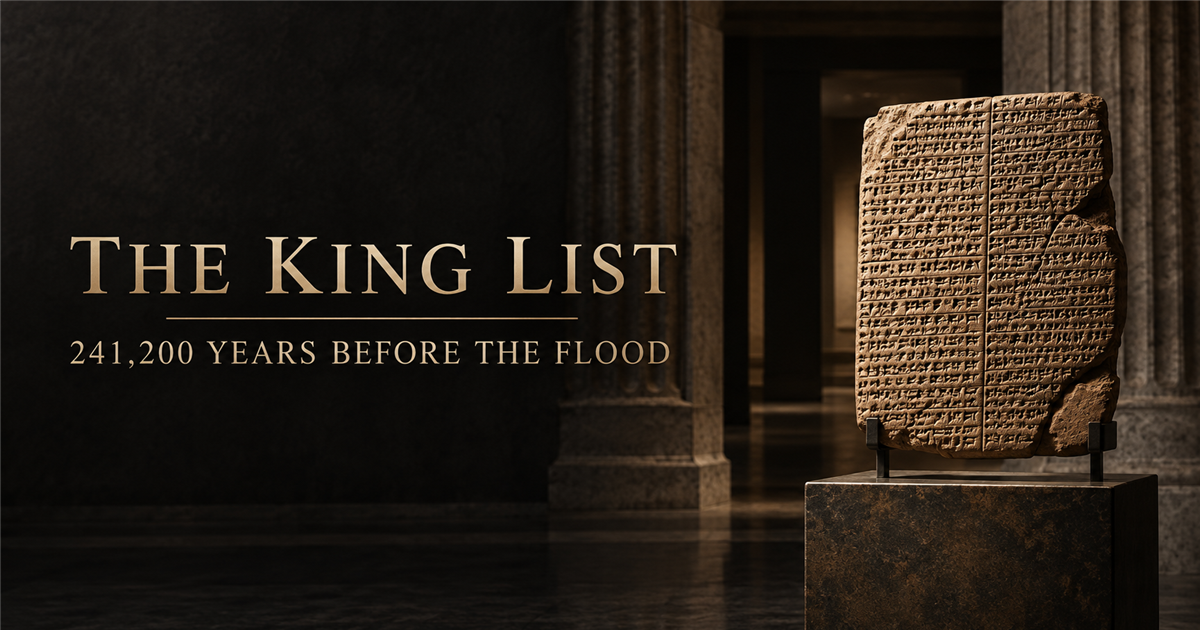
Research archive · Ancient Mesopotamia
Eight rulers. Five cities. 241,200 years.
Before the flood. Before Egypt. Before everything we call civilization.
Kingship descended from heaven.
What if the document means what it says?
Enter the research
Research archive · Ancient Mesopotamia
Eight rulers. Five cities. 241,200 years.
Before the flood. Before Egypt. Before everything we call civilization.
Kingship descended from heaven.
What if the document means what it says?
Enter the researchThe Sumerian King List is one of the oldest royal succession texts in human history. It survives in multiple copies across centuries. Its pre-flood section has never been satisfactorily explained.
Over a dozen copies from multiple cities and centuries. The physical record of the oldest succession text in Mesopotamia — who copied it, how, and why the pre-flood section survived.
Eight rulers. Five cities. Names, durations, and transfers — nothing else. No deeds. No stories. No drama. The most austere record in ancient literature.
28,800 years. 36,000 years. 43,200 years. Mainstream scholarship does not treat these as literal. But the conventional explanations introduce problems of their own.
Five words at the beginning of history. Theology — or a statement of origin? The grammar is directional. The destination is specific. And it happens twice.
Post-flood Mesopotamia yields thousands of burials, including elaborate royal graves. Not one burial has been securely identified with any of the eight pre-flood kings. Where are they buried?
The King List names five cities. Several have been securely identified and excavated. The archaeology confirms the sites. The question is what was happening there.
Kingship descended from heaven and was in Eridu. Eighteen levels of sacred construction spanning three thousand years. The city of Enki, keeper of the knowledge of civilization. Something began here.
The final seat of pre-flood kingship. The city of the flood hero. The site where archaeological flood deposits have been found. The place where the King List, the flood tradition, and the ground converge.
More cities coming: Bad-tibira · Larak · Sippar
The King List does not exist in isolation. It records governance in a region that produced some of humanity’s earliest and most extraordinary achievements — achievements that raise questions the conventional narrative has difficulty answering.
300,000 years of hunting and gathering. Then a cascade of transformations — agriculture, metallurgy, cities, writing, mathematics — concentrated in one region. Climate explains the farming. What explains the rest?
The Tigris and Euphrates flooded at the wrong time for agriculture. Mesopotamian farming required infrastructure that appeared remarkably early. And a potato farmer in Maine never needed a zodiac.
A number system with no obvious ten-finger basis, extraordinarily well suited to astronomical calculation, present at the dawn of Mesopotamian writing. Five thousand years later, sixty is still on your clock. Why sixty?
Farming cultures throughout history have been precise without star charts. Mesopotamian civilization eventually produced one of the most sophisticated astronomical traditions of the ancient world. Who needed it?
Over two hundred cultures preserve traditions of a catastrophic flood. The Sumerian King List records it in five words.
After the flood swept over, kingship descended from heaven a second time. Everything that followed was different.
The reign lengths drop. The political structure changes. The rulers become historically verifiable. The trajectory from the extraordinary to the ordinary — and the question of what changed.
The oldest king list says one ruler went to heaven. A separate legend tells you how — including a description of the earth seen from above. Kingship came down. Etana went up.
Part Two — The Interpretation
What if the pre-flood kings were not kings? What if “kingship descended from heaven” is not theology? What if the numbers are literal, the tombs are missing because the rulers went home, and the Neolithic Revolution was not an accident?
D.H. Trout connects the Sumerian King List to the Great Pyramid of Egypt to the modern UAP record — across 241,200 years, three books, and one framework that either explains everything or explains nothing.
The King List
The Historical Science Fiction Theory That Plants the Seeds
Coming SoonTwenty Years in Egypt — The Historical Science Fiction Theory That Explains Everything
Crowded Skies — The Historical Science Fiction Theory That Connects the Dots
Three questions. Three books. One framework.
The Pyramid The Skies The Author