The Long Silence
Modern humans — Homo sapiens, anatomically indistinguishable from the person reading this sentence — have existed for roughly 300,000 years. For the vast majority of that time, nothing resembling urban civilization appeared.
That sentence deserves to sit for a moment, because the timescale is difficult to absorb.
Three hundred thousand years. If you compressed that span into a single calendar year, with modern humans appearing on January 1st, the first farming villages would not appear until roughly December 23rd. Writing would be invented on December 29th. The Great Pyramid would be built on December 30th. Everything we recognize as urban civilization — every city, every library, every legal code, every empire — occupies the final week of a 365-day year.
For the first 51 weeks, humans were not idle. They developed art, increasingly complex stone tools, long-distance exchange networks, symbolic culture, clothing, shelters, and eventually colonized nearly every environment on Earth — from tropical forests to arctic tundra, from continental interiors to remote Pacific islands. The species was adaptive, inventive, and mobile on a global scale.
But the pace of change was measured in tens of thousands of years. The Acheulean hand axe, a teardrop-shaped stone tool, was manufactured by human hands for over a million years with only gradual refinement. Tool traditions that lasted longer than our entire species has existed. That is not a species incapable of innovation. That is a species in equilibrium — adapted to its environment, meeting its needs, and under no observable pressure to change the fundamental structure of how it lived.
The humans of 100,000 years ago were not stupider than the humans of today. Their brains were the same size. Their capacity for language, abstraction, planning, and cooperation was the same. They were us. They simply had no reason to change what was working.
And then, in what amounts to a tiny fraction of the species' existence, a cascade of transformations began that would eventually produce everything we call civilization.
The Cascade
The Neolithic Revolution — sometimes called the Agricultural Revolution — is the conventional name for the transition from hunting and gathering to farming, animal domestication, and settled life. It is one of the most studied, most debated, and least fully explained transformations in human history.
The word "revolution" is both appropriate and misleading. It is appropriate because the change was total — it eventually altered every aspect of human existence. It is misleading because it was not a single event. The transition unfolded over several millennia, with different elements appearing at different times, and it continued to generate new developments for thousands of years after the first seeds were planted.
The earliest phase — the initial Neolithic transition — appeared in the Fertile Crescent, beginning roughly 11,500 years ago. Its core elements were:
Agriculture. The deliberate cultivation of wild grains — wheat, barley, lentils, flax — transforming humans from consumers of wild plants into managers of domesticated crops. This required not just the act of planting but the understanding of seed selection, soil preparation, irrigation, storage, and seasonal timing. It required settling in one place permanently, which meant abandoning the mobile lifestyle that had sustained the species for 300,000 years.
Animal domestication. Sheep, goats, cattle, and pigs were brought under human management — bred selectively, confined, fed, and exploited for meat, milk, wool, and labor. This is not a simple process. Wild animals do not cooperate with domestication. It requires generations of selective breeding, an understanding of animal behavior, and the infrastructure to contain and feed captive populations.
Permanent settlement. The transition from mobile bands to fixed villages. Permanent structures. Storage facilities. Communal buildings. The entire concept of belonging to a place rather than moving through a landscape. Semi-permanent settlements had existed earlier — Ohalo II is roughly 23,000 years old, and the Natufian stone settlements of the Levant date to roughly 14,000 years ago. But the Neolithic transition made permanent village life the norm rather than the exception.
Pottery. The manufacture of clay vessels for cooking, storage, and transport. Pottery is infrastructure — the ability to store surplus food, to cook grains that are inedible raw, and to carry water.
Textile production. Weaving. The conversion of plant fibers and animal wool into cloth — a manufacturing process with multiple steps and specialized tools.
These were the foundations. What followed, over the next several thousand years, was an extraordinary acceleration within the same broad cultural corridor:
Monumental construction. Göbekli Tepe — built roughly 11,500 years ago by people who had not yet fully adopted agriculture — demonstrates that large-scale communal building projects existed among hunter-gatherers before the conventional agricultural base that supposedly made them possible. Multi-ton carved stone pillars, arranged in monumental enclosures, built by communities that had not yet developed the agricultural economy once assumed necessary for projects of this scale. What organized them? It complicates every neat narrative about how civilization develops.
Irrigation engineering. Sophisticated water management systems appearing early in southern Mesopotamian settlements — canals, levees, drainage systems designed to manage rivers that flooded at the wrong time of year for agriculture.
Metallurgy. First copper, then bronze, then eventually iron. The discovery that certain rocks, when heated to extreme temperatures, release a moldable metal that can be shaped into tools, weapons, and ornaments far superior to stone. Metallurgy is, by any definition, an industrial process — requiring kilns, crucibles, molds, and knowledge of which rocks contain metal.
Cities. The Uruk period, roughly 4000 to 3100 BC, saw the emergence of true urban centers in southern Mesopotamia — cities with tens of thousands of inhabitants, organized into districts, supported by surrounding agricultural hinterlands, and administered by institutional bureaucracies.
Writing. The Sumerian cuneiform system — appearing around 3400 to 3100 BC — was initially used for accounting: recording quantities of grain, numbers of livestock, distributions of rations. It evolved into a full writing system capable of recording law, literature, history, mathematics, and astronomy. Writing is not just a tool. It allows knowledge to be transmitted across generations with a fidelity oral transmission cannot easily match.
Mathematics. Number systems, arithmetic, geometry, measurement. The Sumerian base-60 system. The mathematical foundation for engineering, astronomy, and administration.
Institutional administration. Centralized authority. Bureaucracy. Record-keeping. Taxation. Labor organization. Formal legal codes. The administrative machinery that coordinates thousands of people working toward shared objectives.
Astronomy. Celestial observation, constellation mapping, calendrical systems, and — in later Mesopotamian civilization — increasingly sophisticated predictive models of planetary and lunar behavior. Knowledge of the sky that eventually far exceeded any practical requirement of agriculture or daily life.
None of these later developments sprang directly from the first Neolithic village. Each built on what came before, and the process unfolded across millennia, not overnight. But the trajectory — from the first cultivated grains to urban civilizations with writing, mathematics, law, and astronomical knowledge — occurred within the same broad Near Eastern cultural sphere. And the pace of that trajectory, measured against the 300,000 years that preceded it, is the thing that demands explanation.
The Agricultural Transition in Detail
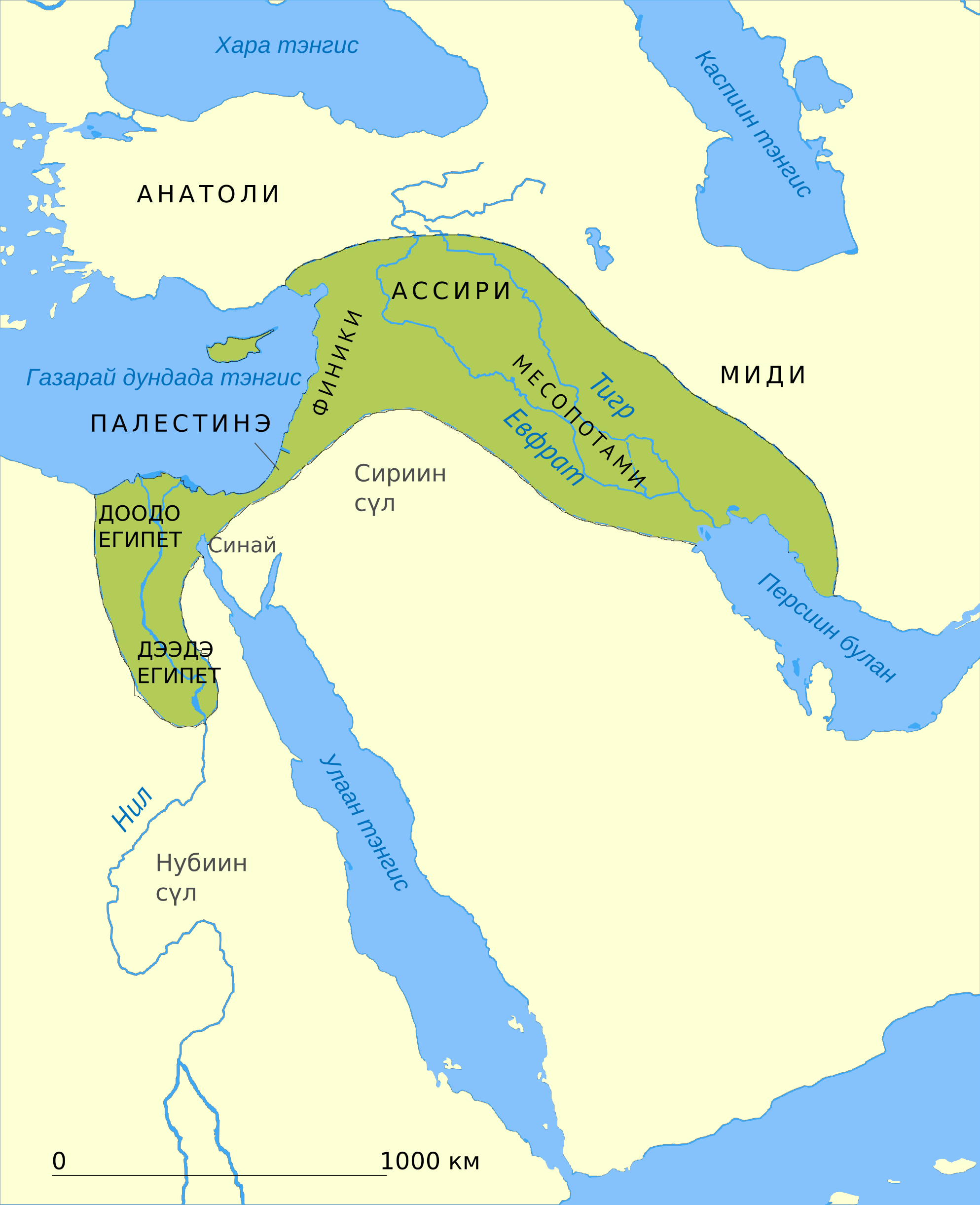
The shift from hunting and gathering to agriculture was not a single decision. It was a process — and a counterintuitive one.
James C. Scott, in Against the Grain, makes a point that deserves more attention than it receives: early agriculture was, by most measurable standards, a step down from hunting and gathering. Skeletal evidence from the transition period shows that early farmers were shorter, less well-nourished, and more disease-prone than the hunter-gatherers who preceded them. Their diet was narrower — dependent on a handful of domesticated grains rather than the diverse wild foods available to a mobile band. Their workload was heavier. Their exposure to animal-borne disease increased dramatically once they began living in close quarters with domesticated livestock.
Why would anyone make this trade?
The conventional answer is population pressure: as human populations grew, wild resources became insufficient, and agriculture was the only way to feed more people from the same land. This is plausible but debated. Some scholars argue that the Fertile Crescent was rich enough in wild resources that population pressure alone does not explain the transition — that the region could have supported larger hunter-gatherer populations than it actually had.
Regardless of the trigger, the mechanics of the transition are well documented in the archaeological record.
The wild ancestors of the first domesticated crops grew naturally in the uplands of the Fertile Crescent — the arc of relatively well-watered hill country stretching from modern Israel and Jordan through southeastern Turkey and into the Zagros foothills of Iran and Iraq. Wild emmer wheat, wild einkorn wheat, and wild barley all grew in this zone. So did the wild ancestors of lentils, peas, chickpeas, and flax.
The earliest evidence of deliberate cultivation — fields prepared for planting, seed selection favoring larger grains, storage facilities for harvested grain — appears in the Levant and southeastern Turkey between roughly 11,500 and 10,000 years ago. The process was gradual at first: communities that had been gathering wild grains began managing the stands, clearing competing vegetation, and replanting seeds from the most productive plants.
Over generations, this selective pressure produced domesticated varieties that differed from their wild ancestors. Domesticated wheat has a tougher rachis — the stem that holds the grain to the stalk — so the seeds stay attached during harvest instead of shattering and dispersing naturally. This is a trait that is useless to a wild plant (it needs the seeds to disperse) but essential for a farmer (he needs the seeds to stay put until he harvests them). The appearance of tough-rachis wheat in the archaeological record is one of the clearest markers of deliberate human selection.
Animal domestication followed a parallel track. Sheep and goats were the earliest — managed, bred, and confined by roughly 10,000 years ago in the Zagros foothills and surrounding regions. Cattle and pigs followed. The process required patience measured in generations: identifying the most docile individuals, breeding them selectively, managing herds through seasons, and developing the infrastructure — pens, shelters, fodder systems — to keep captive animals alive through periods when wild forage was insufficient.
The result was a package: grain agriculture plus animal husbandry plus permanent settlement plus storage. Not invented all at once, but assembled over roughly one to two thousand years in the same broad region. By approximately 9,000 years ago, fully agricultural villages with domesticated crops and animals were established across the Fertile Crescent.
This is the Neolithic Revolution in its narrow sense. It is genuinely remarkable. But it is also, in principle, explicable through conventional means — climate opportunity, human ingenuity, gradual selection, population growth. The harder question is what happened next.
From Copper to Bronze
Metallurgy is the development that most clearly separates the Neolithic from what followed, because metallurgy is not agriculture. It is industry.
The earliest known use of copper in the Near East dates to roughly the eighth or seventh millennium BC — native copper, found in pure metallic form on the surface or in streambeds, hammered cold into simple shapes. Beads, pins, small tools. This is not metallurgy in the full sense. It is metalworking — treating a found material as a particularly malleable stone.
True metallurgy — smelting, the extraction of metal from ore using sustained high-temperature fire — appears later, by roughly the fifth millennium BC. Smelting requires a conceptual leap that cold-hammering does not: the understanding that a dull, unpromising rock, when subjected to the right combination of heat, fuel, and airflow, will yield a substance that can be shaped into almost anything. This is not an intuitive discovery. You cannot arrive at smelting by gradually improving your stone tools. It requires a fundamentally different understanding of materials.
Once copper smelting was established, the next step — bronze — required another conceptual leap. Bronze is an alloy: copper mixed with tin (or sometimes arsenic) to produce a metal harder, more durable, and more useful than either component alone. The discovery that mixing two metals produces a superior third material is not obvious. And tin is not commonly found near copper deposits — the two ores occur in different geological contexts, often separated by hundreds or thousands of kilometers.
This means that bronze production required long-distance trade networks. Because major tin sources were often distant from copper-consuming centers, widespread bronze production depended increasingly on long-distance exchange networks. The precise sources of much ancient Near Eastern tin remain debated, but the distances involved were substantial. The infrastructure required to maintain these supply chains — trade routes, intermediary settlements, agreements between distant communities, transport technology — is itself a form of civilization. The metal demanded the network. The network demanded the administration. The administration demanded the records.
By the third millennium BC, bronze tools and weapons had transformed the economies and military capabilities of the Near East. The Bronze Age — roughly 3300 to 1200 BC in the conventional chronology — saw the rise of the great urban civilizations of Mesopotamia, Egypt, the Indus Valley, and the eastern Mediterranean. Bronze was the material that built the ancient world's infrastructure, armed its soldiers, and filled its treasuries.
The transition from stone to copper to bronze represents something qualitatively different from the agricultural transition. Farming is an extension of gathering — managing what nature provides. Metallurgy is an act of deliberate transformation — extracting useful metal from material that gives little outward indication of what it contains. It requires knowledge that observation alone cannot provide. You cannot watch copper smelt itself. Someone, somewhere, had to figure out that heating a specific type of rock to a specific temperature would produce a material that did not previously exist in that form.
How that knowledge was first acquired is one of the great unanswered questions of early technology. Accidental discovery in a fire or kiln is one proposed explanation. But reconstructing the first successful smelting event remains difficult, because the archaeological record preserves the result far more readily than the thought process that produced it. Someone had to discover that certain apparently ordinary rocks, subjected to the right combination of heat, fuel, airflow, and treatment, could yield metal. How?
Once the knowledge existed, it spread. But the question of how it originated — in a region already undergoing a cascade of transformations that included agriculture, urbanization, writing, and mathematics — is part of the larger pattern that this page examines.
The Conventional Explanation
The standard scholarly explanation for the Neolithic Revolution centers on climate. The end of the last Ice Age — roughly 11,700 years ago, marking the transition from the Pleistocene to the Holocene — produced warmer, more stable conditions that made wild grains more abundant and reliable. Human groups that had previously gathered wild wheat and barley began to manage the stands, then to plant deliberately, then to select for favorable traits. Agriculture emerged as a response to new environmental opportunity.
This explanation has substantial evidence in its favor. The timing correlates: the earliest agricultural sites appear in the centuries following the end of the Younger Dryas cold period, when the climate stabilized into the warmer Holocene. The geography correlates: the wild ancestors of wheat, barley, sheep, and goats are native to the Fertile Crescent. The mechanism is plausible: humans who already knew which plants were edible and which animals were useful began to manage those resources more intensively as conditions improved.
The climate explanation is almost certainly part of the answer. It may even be the largest part of the answer for the initial agricultural transition. But it does not explain the full trajectory that followed, and the things it does not explain are precisely the things that are most interesting.
What Climate Does Not Explain
The sustained acceleration. Agriculture was the beginning, not the end. What requires explanation is not just that humans started farming, but that farming in this particular region was followed by an extraordinary cascade of developments — irrigation, urbanization, writing, mathematics, administration, law, astronomical observation — that eventually produced the first great urban civilizations. Other regions developed agriculture independently. Not all of them generated the same cascading acceleration.
The ecological question. Climate change at the end of the Ice Age was widespread, and agriculture did arise independently in several regions — China, Mesoamerica, the Andes, sub-Saharan Africa, New Guinea. The Fertile Crescent was not the only place where conditions permitted cultivation. But it produced an unusually early and unusually sustained sequence of social and technological transformations. Why did this particular ecological opportunity generate such a dramatic trajectory?
The knowledge gap. Agriculture is not obvious. A hunter-gatherer looking at a field of wild wheat does not intuitively conclude that he should clear the ground, plant seeds at regular intervals, irrigate the field, wait several months, harvest the grain, thresh it, store it, and save a portion for next year's planting. The conventional explanation assumes that humans figured it out through trial and error — and they certainly could have. But the comprehensiveness of the Fertile Crescent transition — multiple crops, multiple animals, irrigation, storage technology, all within a few millennia — raises the question of how efficiently and systematically the knowledge was acquired.
The disproportionate trajectory. Several millennia after the first cultivation experiments, the same broad region had produced cities, writing, sophisticated mathematics, bureaucratic administration, and increasingly systematic observation of the sky. Agriculture may explain the beginning of that trajectory. Does it fully explain where the trajectory ended?
A farmer needs to know when to plant. He does not need to know the orbital periods of the planets. A merchant needs to count his inventory. He does not need base-60 mathematics. A village needs a headman to settle disputes. It does not need a written legal code and a scribal school that trains students for years in a curriculum that includes astronomical tables.
The trajectory that began with farming eventually produced knowledge and institutions far beyond what farming required. Climate explains the opportunity. Human ingenuity explains the adaptation. What explains the acceleration — and the direction it took?
The Pace Problem
The pace of change is perhaps the deepest puzzle.
For 300,000 years, the rate of human cultural innovation was slow. Not zero — humans achieved remarkable things across those millennia. But the timescale of fundamental change was measured in tens of thousands of years.
Then, within roughly seven or eight thousand years — less than three percent of the species' existence — a succession of transformations began within the same broad Near Eastern cultural sphere that ended in cities, writing, mathematics, law, and astronomy.
The conventional explanation frames this as the natural result of a feedback loop: agriculture produces surplus, surplus enables specialization, specialization accelerates innovation, innovation produces more surplus. The loop feeds itself, and the pace of change accelerates.
This is a reasonable model. It may even be correct. But it requires an ignition event — a point at which the loop starts. And the question of what ignited it, in one specific region, after 300,000 years of the loop not starting anywhere, is the question that the conventional narrative has the most difficulty answering with precision.
What changed? Why then? Why there? Why did the process accelerate?
What the Fertile Crescent Produced
It is worth pausing to appreciate the sheer scale of what emerged from this one region.
From the Fertile Crescent — and specifically from Mesopotamia — came some of humanity's earliest cities, writing systems, mathematical traditions, legal traditions, bureaucratic administrations, and large-scale irrigation societies. Not all of these were Sumerian. The Akkadians, Babylonians, Assyrians, and Persians built on what Sumer began. But the foundation — the agricultural base, the urban model, the writing system, the mathematical tradition, the administrative template — was laid in southern Mesopotamia, in the cities that appear on the Sumerian King List, in the millennia following the period that the King List records.
Other civilizations developed independently and produced extraordinary achievements — Chinese civilization, the Indus Valley, Mesoamerica, Egypt. Each deserves study and admiration on its own terms. But the Fertile Crescent trajectory was among the earliest and the most comprehensive, and its influence — through trade, conquest, and transmission — shaped every subsequent civilization in western Asia, Europe, and North Africa.
The question is not whether the people of the Fertile Crescent were remarkable. They were. The question is whether the explanation — climate change plus human ingenuity — is sufficient to account for the speed, the comprehensiveness, and the intellectual content of the trajectory that unfolded from this one region.
The Question
Humans learned to farm independently in almost every part of the world. The Chinese domesticated rice. The Mesoamericans domesticated maize. The Andean peoples domesticated the potato. Farming is something humans demonstrably figure out, given enough time and the right conditions.
But in one broad region, early farming was followed by an extraordinary cascade of developments that eventually produced the first great urban civilizations — with writing, mathematics, astronomy, law, and institutional administration that far exceeded any practical requirement of agricultural life.
Climate explains the farming. Human ingenuity explains the adaptation. What explains the rest?
The question is not controversial. It is simply not asked with sufficient force. The conventional narrative slides from "they started farming" to "they built civilization" as if the second follows inevitably from the first. It does not. Thousands of cultures farmed for millennia without producing writing, mathematics, or astronomy. Farming is a necessary condition for civilization. It is not a sufficient one.
Something else happened in the Fertile Crescent — or, at the very least, something changed. An early agricultural transition became a trajectory that, over several thousand years, produced cities, writing, mathematics, law, administration, and systematic astronomy at a pace unlike anything in the preceding human record. Was agriculture itself enough to ignite that cascade?
The Sumerian King List records a period of governance in exactly this region, lasting 241,200 years, administered by rulers whose reign lengths no human biology can explain, beginning with an authority that "descended from heaven."
The question of what happened in the Fertile Crescent and the question of what the King List records may be the same question.
Sources & further reading
Sources: James C. Scott, Against the Grain: A Deep History of the Earliest Agrarian States (2017); Ofer Bar-Yosef, "The Natufian Culture in the Levant" (1998); Harriet Crawford, Sumer and the Sumerians (2004); Klaus Schmidt, Göbekli Tepe: A Stone Age Sanctuary in South-Eastern Turkey (2012); British Museum, "History of Writing" collection resources.