The Final Entry
The Sumerian King List records Shuruppak as the fifth and last city to hold kingship before the flood.
"In Shuruppak, Ubara-Tutu became king; he ruled for 18,600 years."
>
"One king ruled for 18,600 years. Then the flood swept over."
Ubara-Tutu is the last pre-flood ruler. His reign is the shortest in the pre-flood section — 18,600 years, compared to the longest at 43,200. His reign length, unlike the first six rulers, is not a clean multiple of 3,600. And his city is the one where the pre-flood era ends.
After Ubara-Tutu, the document records five words — "Then the flood swept over" — and the pre-flood world is finished.
Kingship descends from heaven a second time. The post-flood era begins at Kish. And Shuruppak disappears from the King List entirely. It never receives kingship again.
The Flood Hero's City
Shuruppak's significance extends beyond the King List into the broader Mesopotamian flood tradition.
In the Sumerian flood narrative — the text sometimes called the Eridu Genesis — the hero who survives the flood is Ziusudra, a king of Shuruppak. The god Enki warns Ziusudra of the coming flood; the surviving text is fragmentary, but Ziusudra survives aboard a large vessel and is granted eternal life.
In the Babylonian tradition preserved in the Epic of Gilgamesh, the flood hero is Utnapishtim — and he too is associated with Shuruppak. In the Atra-hasis epic, another Babylonian flood account, the hero is likewise connected to this city.
In some traditions, Ziusudra is identified as the son of Ubara-Tutu — the last ruler on the pre-flood King List. If this identification is accurate, the convergence is striking: the final pre-flood king's own son is the man who survived the catastrophe that ended the era his father governed.
The King List and the flood tradition meet at Shuruppak. The administrative record and the narrative tradition name the same city, at the same moment, at the end of the same era. One says "then the flood swept over." The other says what happened to the people who were there when it did.
Tell Fara
The archaeological site identified with ancient Shuruppak is Tell Fara, located in southern Iraq between the ancient sites of Nippur and Uruk. The site was excavated in several campaigns — most notably by Robert Koldewey and Friedrich Delitzsch's German expedition in 1902-1903, and later by Harriet Martin and others, particularly the University of Pennsylvania's work in the 1930s.
Tell Fara is not a dramatic site. It is not large by Mesopotamian standards, and it has not yielded the monumental architecture or spectacular grave goods found at Ur or Uruk. What it has yielded is something more significant for this inquiry: a substantial collection of cuneiform tablets, evidence of a well-organized urban settlement, and — critically — physical evidence of catastrophic flooding.
The Tablets of Shuruppak
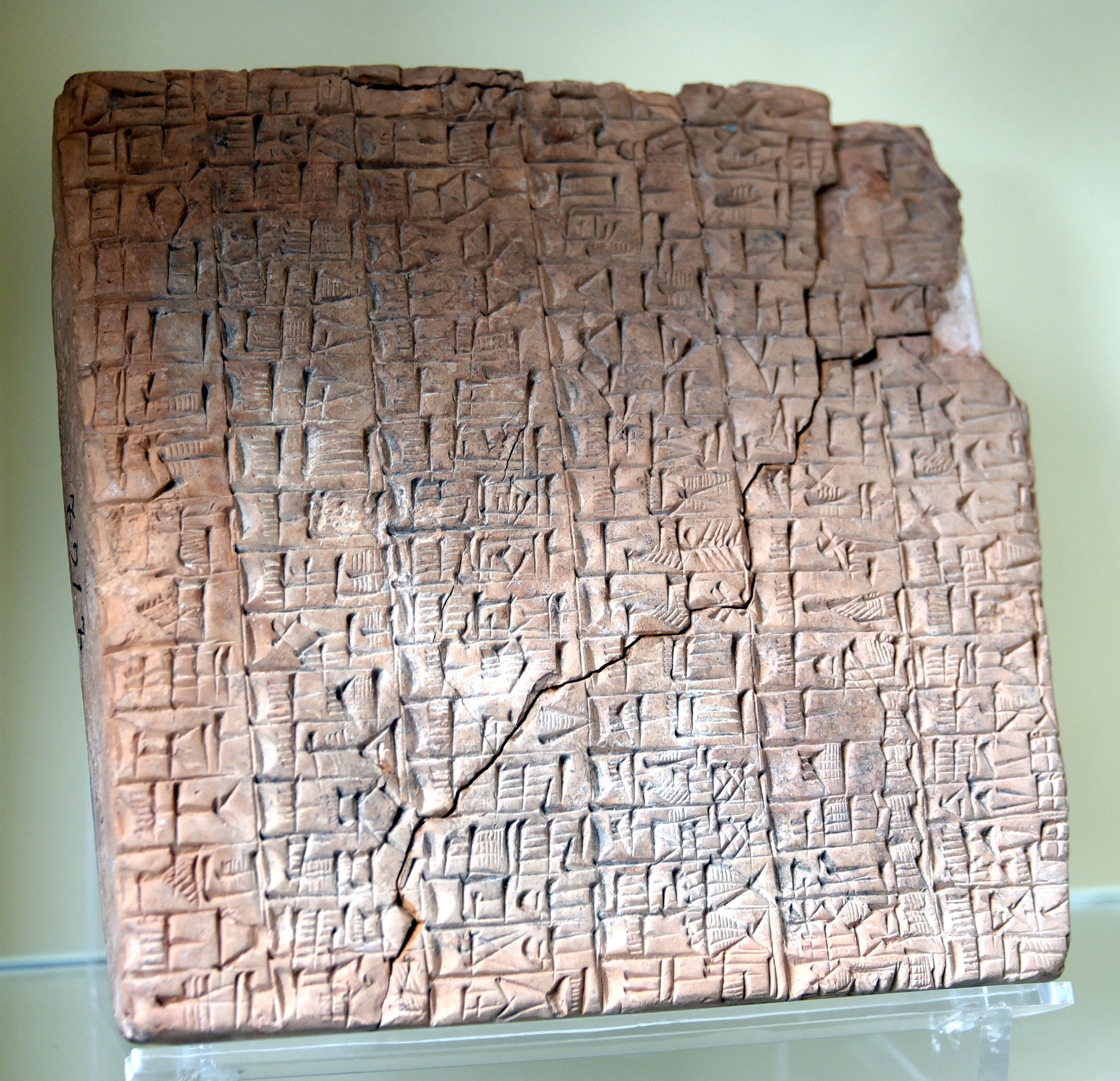
The site produced a major archive of cuneiform tablets dating to the Early Dynastic period — roughly 2600–2500 BC. These tablets provide a vivid picture of a functioning Sumerian city: administrative records, economic texts, land-sale contracts, lists of professions, and literary compositions.
Among the literary texts found at Shuruppak is a remarkable composition known as the "Instructions of Shuruppak" — a wisdom text in which a father (named Shuruppak) gives advice to his son, Ziusudra. The text is one of the oldest known examples of wisdom literature, and it places Ziusudra explicitly at Shuruppak. The advice itself is practical and moral — don't quarrel, don't buy a donkey that brays too much, don't guarantee another man's debt — the kind of wisdom that a father passes to a son who will need to manage in the world.
The text treats Shuruppak and Ziusudra as real people in a real place, not as mythological figures in a symbolic narrative. A father gives his son advice about daily life. The flood has not happened yet. The world is still ordinary.
This literary context matters because it connects the flood tradition to a specific, documented community — a city with archives, contracts, professions, and fathers who worried about their sons. Whatever happened at Shuruppak happened to people who were keeping records, conducting business, and living organized urban lives.
The Flood Deposits
The archaeological evidence for catastrophic flooding at Shuruppak is real.
Excavations at Tell Fara revealed a layer of water-deposited sediment separating earlier occupation levels from later ones. This layer — a deposit of silt and clay consistent with prolonged flooding — has been identified at the site and dated to approximately 2900 BC by correlation with surrounding stratigraphy and associated material.
Below the flood deposit: the earlier settlement, with its architecture, pottery, and material culture.
Above the flood deposit: a rebuilt settlement, showing continuity of habitation but also evidence of disruption and reorganization.
An important caution is necessary here. The flood deposit at Shuruppak is real, but it is not the only flood deposit found at a Mesopotamian site. Leonard Woolley found a thick layer of water-deposited silt at Ur as well, and flood horizons have been identified at Kish and other locations. These deposits do not all date to the same event. Southern Mesopotamia — a low-lying flood plain between two powerful rivers — experienced catastrophic flooding repeatedly across its history. The deposit at any single site records a local catastrophe, not necessarily a universal one.
Scholars have debated for a century whether any single flood event can be identified as "the flood" of Mesopotamian tradition, or whether the literary tradition represents a composite memory of multiple disasters experienced at different times and places.
This page does not attempt to resolve that debate. What it observes is this:
The King List says the flood happened at the end of the pre-flood era. The last pre-flood city is Shuruppak. The archaeological site identified with Shuruppak has yielded flood deposits dated to approximately 2900 BC. The Mesopotamian flood tradition names Shuruppak as the city of the flood hero.
The textual tradition and the physical evidence converge at the same site. Whether the deposit at Tell Fara is the specific event the King List records, or one of several events that contributed to the tradition, the convergence is real.
What Shuruppak Was
The picture that emerges from the tablets and the archaeology is of a modest but prosperous Sumerian city — not a capital, not a center of imperial power, but a functioning urban community with institutional depth.
Shuruppak had professional scribes. Its archives demonstrate a bureaucratic culture capable of recording economic transactions, managing land distribution, and maintaining literary traditions. The "Instructions of Shuruppak" — a text sophisticated enough to survive in copies across centuries — was composed or preserved here.
Shuruppak had an organized economy. The administrative tablets record grain distributions, labor allocations, and trade. This was not a village. It was a city with the institutional machinery to manage surplus, distribute resources, and maintain records.
And Shuruppak had a relationship with the broader Sumerian world. Its tablets reference other cities. Its trade goods came from elsewhere. Its scribal traditions connected it to the literary culture shared across southern Mesopotamia.
This is the city the King List places at the end of the pre-flood era. Not a primitive settlement. Not a mythological location. A real, documented, archaeologically confirmed urban community with archives, institutions, and a literate professional class — overtaken by a flood that left physical traces in the ground.
The Convergence
Shuruppak is the point where the King List, the flood tradition, and the archaeology meet most closely.
The King List says: governance was at Shuruppak. The last pre-flood ruler was Ubara-Tutu. Then the flood swept over.
The flood tradition says: the hero Ziusudra, son of a ruler of Shuruppak, was warned by a god that the flood was coming. He built a boat and survived.
The "Instructions of Shuruppak" say: a father named Shuruppak gave practical advice to his son Ziusudra in a world that had not yet been destroyed.
The archaeology says: Tell Fara was a functioning Sumerian city with archives, institutions, and economic activity. Flood deposits have been found at the site, dated to approximately 2900 BC.
Few places in Mesopotamia offer this density of convergence: a city named at the end of the antediluvian King List, a flood hero repeatedly associated with that city, a wisdom tradition linking him to Ubara-Tutu's family line, and an archaeological flood horizon at the site itself.
The convergence does not prove that the King List's account is literal history. It does not prove that Ubara-Tutu was a real individual who ruled for 18,600 years. It does not prove that Ziusudra built a boat and survived a divine punishment.
But it eliminates one common dismissal: the claim that the pre-flood King List describes a purely imaginary world with no connection to the archaeological record. Shuruppak is real. Its archives are real. Its flood deposits are real. And its name appears in the King List, in the flood tradition, and in the ground — all telling the same story from different angles.
What happened at Shuruppak?
The flood swept over. And everything before it became the world we are still trying to understand.
Sources & further reading
Sources: Harriet Martin, Fara: A Reconstruction of the Ancient Mesopotamian City of Shuruppak (1988); Robert D. Biggs, Inscriptions from Tell Abu Salabikh (1974); Bendt Alster, The Instructions of Shuruppak (2005); Electronic Text Corpus of Sumerian Literature (ETCSL), The Sumerian King List, t.2.1.1; Harriet Crawford, Sumer and the Sumerians (2004).