Counting Systems
Human cultures have counted in many bases. Base-10 is the most widespread — almost certainly because humans have ten fingers, and fingers are the first counting tool every child discovers. But it is not universal. Cultures around the world have used base-5 (one hand), base-20 (fingers and toes), and base-12 — possibly derived from counting the three phalanges of four fingers using the thumb as a pointer, which gives twelve per hand. Combinations of these systems appear in many traditions.
Base-10 dominates because it is intuitive. A species with ten fingers gravitates toward ten. The body teaches the math.
Base-60 is different. One hypothesis proposes that it arose from combining base-12 and base-5 — counting phalanges on one hand and tracking groups of twelve on the other hand's five fingers. This is plausible. It is also a hypothesis. No Sumerian text explains why sixty was chosen. No scholar has demonstrated the definitive origin.
After over a century of study, historians of mathematics have proposed divisibility, metrology, combinations of earlier counting systems, finger-joint counting, astronomical observation, and other explanations. None has achieved consensus.
The question "why sixty?" remains open.
What Happened in Sumer
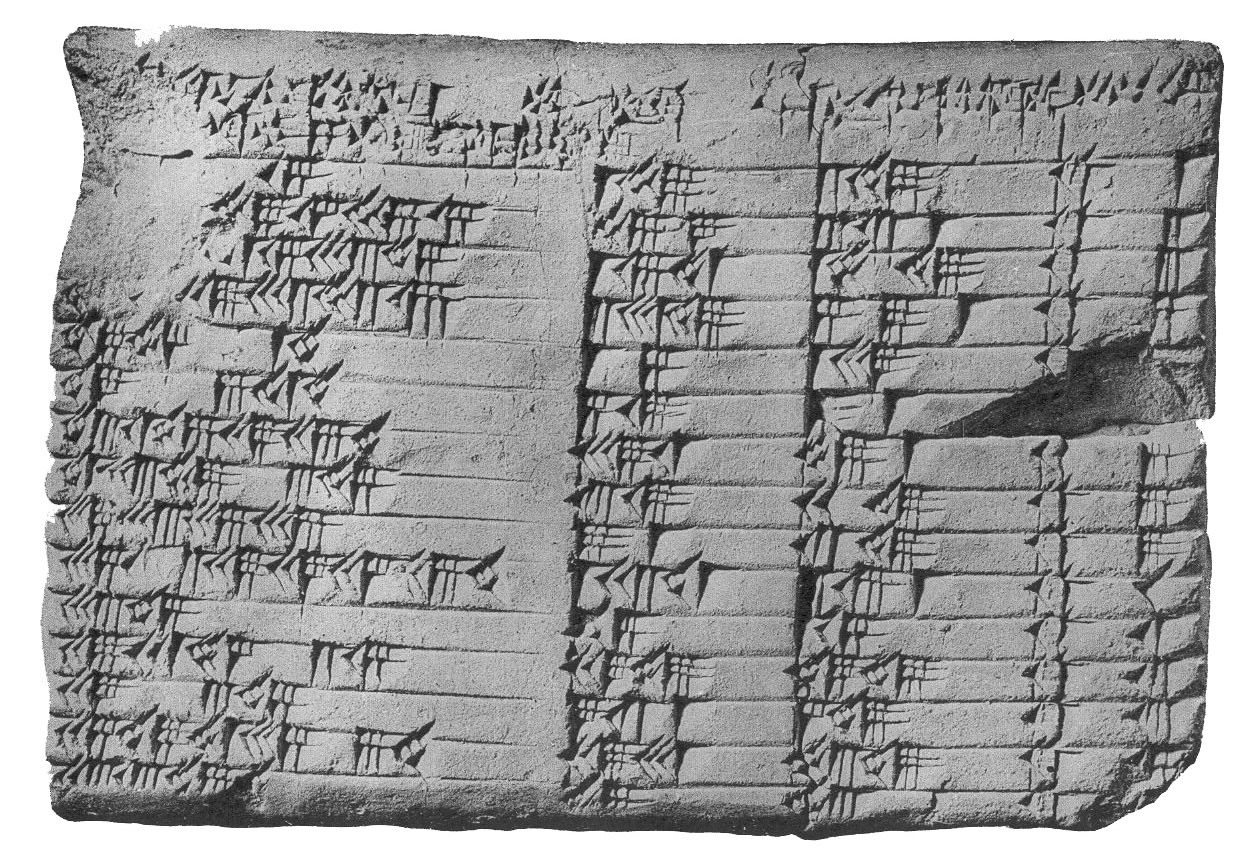
The early Sumerian numerical record is not as simple as "they counted in sixties." At Uruk and related sites — in texts dating to roughly 3200–3000 BC, the very dawn of writing — scribes used multiple counting and metrological systems depending on what they were counting or measuring. There were systems for discrete objects, for grain, for land, for capacity. Some of these systems had elements of other bases. The mathematical landscape of early Sumer was practical, varied, and built for specific tasks.
But sixty is already there. The Late Uruk numerical texts already contain sexagesimally structured numbers. At the very beginning of the written record, sixty is embedded in the system — not as the only way of counting, but as a structural presence that no other early civilization's mathematics shares.
Over the following centuries — through the Ur III period and into the early second millennium BC — the sexagesimal system was inherited and substantially elaborated by the Akkadian and Babylonian civilizations that succeeded Sumer. The fully developed positional notation that most people think of when they hear "base-60 mathematics" emerged during the late Sumerian and early Babylonian periods. The later achievements are evidence of how powerful and durable the inherited system proved to be.
But the presence of sixty at the foundation — already there at Uruk, already embedded in the earliest written mathematical tradition — that is Sumerian. And it has never been satisfactorily explained.
What Base-60 Does Well
Whatever its origin, the properties of base-60 are not disputed. They are mathematical facts, and they explain why the system has persisted for five thousand years.
Divisibility. Sixty divides evenly by 2, 3, 4, 5, 6, 10, 12, 15, 20, and 30. Twelve factors — more than any smaller number. Fractions that are awkward in base-10 — one-third, one-sixth, one-twelfth — become clean, finite expressions in base-60. For any mathematics that involves frequent division, this is a significant practical advantage.
Angular measurement. The division of the circle into 360 degrees has its roots in Mesopotamian mathematics. The full system of degrees, minutes of arc, and seconds of arc was refined over many centuries by Babylonian, Greek, and Islamic astronomers — but the sexagesimal foundation is Sumerian. The reason your compass reads in degrees is that Sumerian mathematicians established the framework that later civilizations built upon.
Time measurement. Sixty minutes in an hour and sixty seconds in a minute are direct inheritances from the Mesopotamian sexagesimal tradition. The French Revolution attempted to replace this system with decimal time — ten hours in a day, one hundred minutes in an hour. The experiment lasted roughly two years before the old system returned. Not because of tradition alone, but because base-60 time divisions are genuinely more practical. An hour splits evenly into halves, thirds, quarters, fifths, sixths, and twelfths. A decimal hour does not.
Astronomical calculation. Mesopotamian astronomy was built on base-60 mathematics. The two cannot be separated. The angular measurements that tracked planetary positions, the time divisions that recorded observations, the mathematical tables that predicted celestial events — all of it ran on the sexagesimal system. By the first millennium BC, Mesopotamian astronomers had developed predictive models for lunar eclipses and planetary positions that rank among the most sophisticated predictive astronomy of the ancient world.
The Astronomy Problem
The conventional explanation for Mesopotamian astronomical knowledge begins with agriculture — tracking the seasons, timing the planting, predicting the river floods.
This page's companion article, "The Rivers," examines that explanation and finds it insufficient. A farmer in Mesopotamia — or anywhere else — does not need planetary-orbit calculations or eclipse predictions to know when to plant barley. A potato farmer in Maine has never consulted a star chart. He watches the frost, the soil, the angle of the morning sun. Farmers are precise about their environment without astronomical instruments. They always have been.
The astronomical knowledge is disproportionate to the agricultural need. The mathematics that supports it is disproportionate to the commercial and administrative needs of a Bronze Age economy. And the number system underneath both — base-60 — is disproportionate to the counting needs of a species with ten fingers.
These disproportions do not prove anything by themselves. But they are worth noticing, because they point in the same direction: the Sumerians possessed knowledge and tools that exceeded the practical requirements of the society that used them.
The Persistence
Five thousand years.
That is how long the Sumerian base-60 system has been in continuous use. Not in museums. Not in scholarly reconstructions. In daily, practical, uninterrupted use by billions of people who have no idea where it came from.
Sixty seconds in a minute. Sixty minutes in an hour. Three hundred and sixty degrees in a circle. Every clock. Every compass. Every navigation instrument. Every telescope. Every pilot checking a heading, every surveyor measuring an angle, every astronomer recording a position in the sky — all of them using a mathematical framework that originated in southern Mesopotamia before the pyramids were built.
Other ancient systems have been replaced. Egyptian hieroglyphs gave way to Greek, then Latin, then modern alphabets. Roman numerals gave way to Hindu-Arabic notation. Sumerian cuneiform itself has been dead for two thousand years. But the number system survived. It outlasted the writing, the language, the civilization, and every empire that followed.
A system that persists for five thousand years is not a quirk of history. For time and angular division, nobody has displaced it.
The Question
Here is what we can say with confidence:
Sumer produced a sexagesimal mathematical tradition of extraordinary durability and sophistication. Its precise origin remains uncertain. Sixty is unusually useful because of its divisibility. The mathematics built on it became deeply associated with astronomical calculation. And echoes of that tradition remain embedded in how we measure time and angles thousands of years later.
Here is what remains unexplained:
Why did one civilization — alone among all ancient cultures — build its mathematics on a base that has no obvious ten-finger basis, and why was that choice so extraordinarily well suited to astronomical calculation, angular measurement, and the expression of very large numbers?
The question is whose fingerprint it is.
Five thousand years later, sixty is still on your clock.
Why sixty?
D.H. Trout has a theory.
The King List: The Historical Science Fiction Theory That Plants the Seeds.
Sources & further reading
Sources: Otto Neugebauer, The Exact Sciences in Antiquity (1957); Eleanor Robson, Mathematics in Ancient Iraq (2008); Duncan J. Melville, "Sumerian and Babylonian Mathematics," Oxford Handbook of the History of Mathematics (2009).