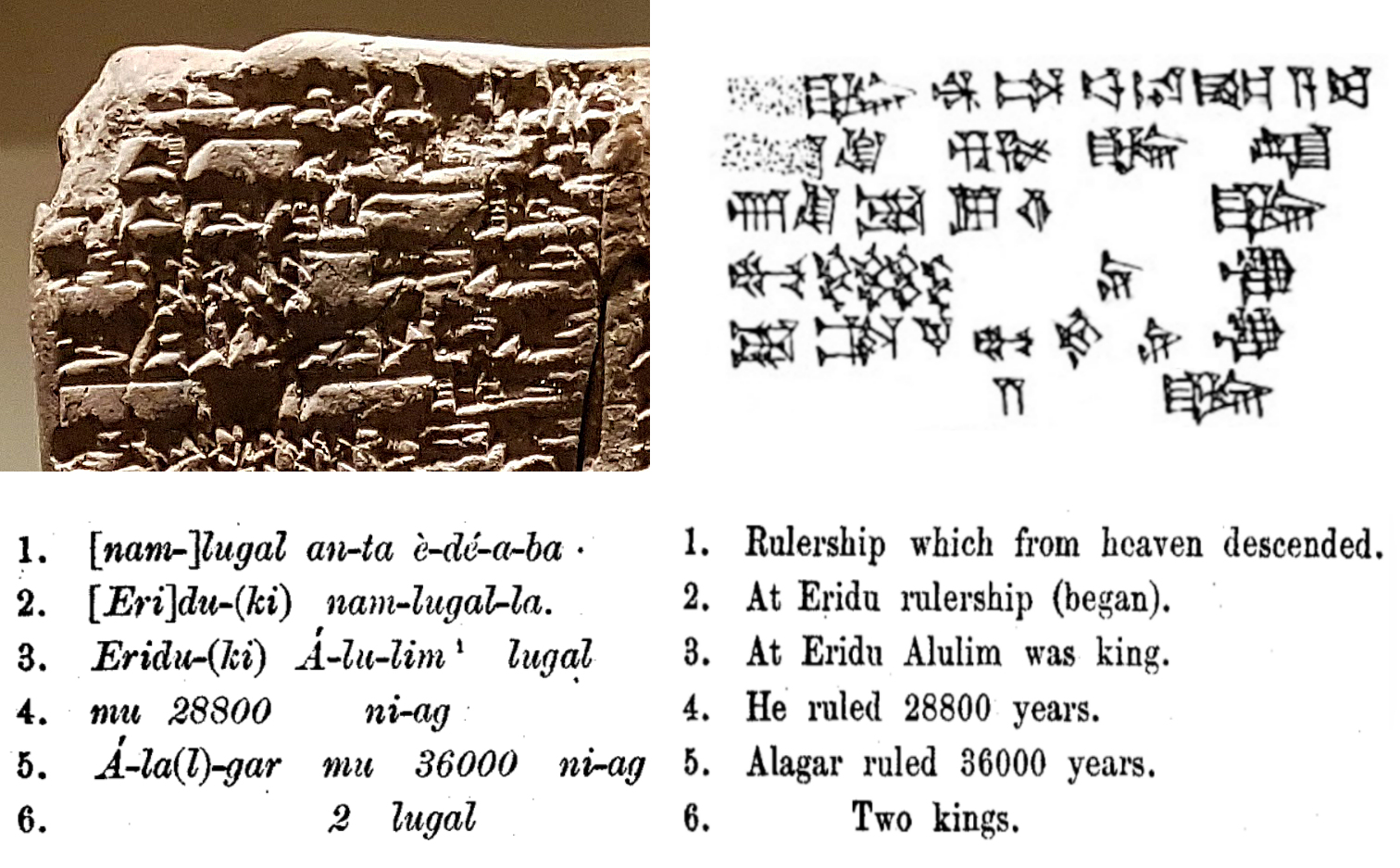
The Weld-Blundell version of the Sumerian King List records eight rulers who reigned before the flood. The document provides three pieces of information for each: a name, a city, and a duration of rule. Nothing else. No deeds. No battles. No divine interventions. No stories. Just the data.
This is, by itself, one of the most important observations about the pre-flood section. Ancient texts that describe legendary rulers almost always describe what those rulers did. Gilgamesh built the walls of Uruk. Sargon conquered the known world. Hammurabi wrote the laws. The pre-flood section of the King List describes none of this. It is a personnel roster — names, assignments, and durations. The kind of document that an institution produces when tracking who was posted where and for how long.
What follows is the complete pre-flood record as preserved on the Weld-Blundell Prism, with everything that is known — and everything that is not known — about each entry.
The First City: Eridu
The King List opens with a statement that has been debated for a century:
"When kingship descended from heaven, the kingship was in Eridu."
Eridu was the assignment. Kingship — nam-lugal — was the authority. Heaven was the source. The sentence identifies an origin, a destination, and a form of governance, in the same administrative tone that the rest of the document maintains throughout.
The word translated as "kingship" is nam-lugal. The root word lugal is typically translated as "king," but its literal meaning is closer to "big man" or "great person." It is a title of authority and stature, not necessarily of hereditary monarchy. A lugal could be a ruler, a leader, a person of significant rank — the term does not, by itself, specify how the authority was acquired or whether it was inherited.
The phrase "descended from heaven" uses the Sumerian word an, which means both "heaven" and "sky." In Sumerian cosmology, an is the realm above — the domain of Anu, the supreme deity in the Sumerian pantheon. Scholars have generally interpreted the phrase as a theological statement: the gods granted kingship to the city of Eridu as a divine gift.
That interpretation is possible. It is also not the only reading the text supports.
Alulim of Eridu — 28,800 years
Alulim is the first name on the list. He ruled at Eridu for 28,800 years.
Nothing else is recorded about him. No other Sumerian text describes his deeds, his character, his family, or his death. He exists in the historical record as a name, a city, and a number. The name itself has been analyzed by Sumerologists without producing a consensus translation — it may mean "stag" or it may be a compound whose elements have not been satisfactorily parsed.
The number — 28,800 years — is divisible by 3,600, the Sumerian sar, which was the largest standard unit in the base-60 number system. Alulim's reign equals exactly 8 sar. Some scholars have argued that the use of round sar multiples indicates that the numbers are symbolic constructions rather than literal durations — mathematical expressions of significance rather than actual counts of years.
Others have noted that if the numbers are purely symbolic, it is unclear what they symbolize. A symbolic number should mean something. Eight sar should represent a concept, a quality, a cosmic principle. No scholar has convincingly identified what concept Alulim's 8 sar is supposed to encode. The number sits in the text with no explanation and no interpretive key.
What archaeology knows about Eridu:
Eridu is among the oldest known settlements in southern Mesopotamia. The site, now called Tell Abu Shahrain, lies in the far south of modern Iraq. Excavations conducted in the 1940s and 1950s revealed a sequence of eighteen temple structures built one on top of another, with the deepest levels dating to approximately 5400 BC.
The earliest temple — Temple XVII at the bottom of the sequence — is a small, single-room structure with a niche that may have served as an altar or offering platform. Each successive temple was built directly over the remains of the previous one, growing larger and more elaborate as the sequence progresses upward through the centuries. The continuity is remarkable: the same site, the same orientation, the same basic plan, rebuilt and expanded over and over for thousands of years.
Eridu was associated with the deity Enki (later known as Ea in Akkadian) — the god of fresh water, wisdom, craftsmanship, and creation. The association with fresh water is significant because Eridu's location, at the edge of the marshlands where the Euphrates met the sea, gave it access to the fresh water that the surrounding region lacked.
The King List says kingship began at Eridu. Archaeology says settlement and temple construction began at Eridu earlier than at any other site in southern Mesopotamia. The document and the excavation agree on the starting point. They disagree on what was happening there — and for how long.
Alaljar of Eridu — 36,000 years
Alaljar is the second name on the list. He succeeded Alulim at Eridu and ruled for 36,000 years — exactly 10 sar.
Like Alulim, Alaljar has no presence in any other surviving Sumerian text. No deeds. No attributes. No stories. The name, the city, and the number are the entire record.
After Alaljar, the King List records:
"Two kings ruled for 64,800 years. Then Eridu fell and its kingship was taken to Bad-tibira."
The total for Eridu — 64,800 years across two rulers — is followed by a transfer of governance. The language is striking in its terseness. The city fell. Kingship was taken to the next city. No battle narrative. No named conqueror. No heroics. No explanation. Just a status change and a relocation, recorded in the same administrative tone as everything else in the document.
This terseness is one of the most distinctive features of the pre-flood section. In the post-flood portion of the King List, the falls of cities are sometimes accompanied by narrative detail — named conquerors, military campaigns, the fate of the defeated ruler. In the pre-flood section, there is none of this. Cities fall. Kingship transfers. The record moves on. Whatever happened at these transitions, the document does not consider it worth describing.
The Second City: Bad-tibira
En-men-lu-ana of Bad-tibira — 43,200 years
En-men-lu-ana ruled at Bad-tibira for 43,200 years — 12 sar. This is the longest single reign in the pre-flood section. The name can be translated approximately as "lord of the powers of heaven and earth" or "lord whose powers are heaven-and-earth," though the precise meaning is debated.
Bad-tibira received governance after Eridu "was abandoned." The name Bad-tibira itself is significant: it translates roughly to "Wall of the Copper Workers" or "Fort of the Metalworkers." This is not a ceremonial title. It is a functional description. The city was named for what it did — metalworking, specifically copper.
Copper metallurgy in Mesopotamia is conventionally dated to the sixth or fifth millennium BC, during the Ubaid and early Uruk periods. Bad-tibira's association with metalworking in the King List places it in a specific functional role — an industrial center within the pre-flood administrative structure. If Eridu was the base of operations, Bad-tibira was the workshop.
What archaeology knows about Bad-tibira:
The site of Bad-tibira has been identified with Tell al-Madineh in southern Iraq, but it has not been extensively excavated. What little work has been done confirmed occupation layers consistent with early Sumerian settlement, but the site has not received the level of archaeological attention given to Eridu, Ur, or Uruk.
This is a recurring problem in Mesopotamian archaeology. Iraq's political instability over the past half century has severely limited excavation, and many of the sites named in the King List remain partially or wholly unexcavated. The evidence that could confirm or challenge the document's claims about these cities is in the ground, and it may stay there for the foreseeable future.
En-men-gal-ana of Bad-tibira — 28,800 years
En-men-gal-ana ruled for 28,800 years — 8 sar, the same duration as Alulim's reign at Eridu. The name translates approximately to "lord of the great powers of heaven." Like his predecessor, he appears in no other surviving text.
Dumuzid of Bad-tibira — 36,000 years
Dumuzid ruled at Bad-tibira for 36,000 years — 10 sar.
The name Dumuzid is notable because it also appears in Sumerian mythology. A figure called Dumuzid (Tammuz in later Akkadian) is a central character in the myth of Inanna's descent to the underworld — he is the shepherd-god who becomes Inanna's husband and is eventually taken to the underworld as her substitute. The mythological Dumuzid is associated with fertility, shepherding, and the seasonal cycle of death and rebirth.
Whether the Dumuzid of the King List is the same figure as the Dumuzid of mythology is debated. The King List simply records him as a ruler at Bad-tibira. The mythology gives him a character, a story, and a fate. The two traditions may describe the same individual — a real person who was later mythologized — or they may share nothing but a name.
This ambiguity is itself instructive. The mythological Dumuzid has elaborate stories. The King List Dumuzid has a name, a city, and a number. The same figure, in two different types of document, receives two entirely different treatments. The myth tells stories. The list records data. The two formats serve different purposes, and the scribes who maintained them knew the difference.
After Dumuzid:
"Three kings ruled for 108,000 years. Then Bad-tibira fell and its kingship was taken to Larak."
Again: the city fell. No battle described. No conqueror named. Just the transfer.
The Third City: Larak
En-sipad-zid-ana of Larak — 28,800 years
En-sipad-zid-ana is the only ruler assigned to Larak. He ruled for 28,800 years — 8 sar. The name translates approximately to "faithful shepherd lord of heaven."
Larak is the most obscure of the five pre-flood cities. Its location has been tentatively identified with Tell al-Wilayah in southern Iraq, but the identification is not certain, and the site has not been significantly excavated. We know almost nothing about Larak beyond what the King List tells us — which is one name, one number, and the fact that kingship arrived from Bad-tibira and departed for Sippar.
"One king ruled for 28,800 years. Then Larak fell and its kingship was taken to Sippar."
Larak is a blank. And blanks are their own kind of evidence. The scribe who compiled the King List included Larak even though there was almost nothing to say about it — one ruler, one term. A compiler inventing a mythology would have skipped Larak entirely or embellished it to justify its inclusion. A compiler recording a source document copied what the source contained, even when the source contained very little.
The Fourth City: Sippar
En-men-dur-ana of Sippar — 21,000 years
En-men-dur-ana ruled at Sippar for 21,000 years. This is the first reign length in the pre-flood section that is not a clean multiple of 3,600. Twenty-one thousand years equals 5.833 sar — not a round number in any base. This complicates the argument that the numbers are purely symbolic constructions built from the sar unit. If the system were symbolic, consistency would be expected. En-men-dur-ana's reign breaks the pattern.
The name translates approximately to "lord of the powers of Dur-an-ki." Dur-an-ki means "bond of heaven and earth" — it was a title associated with the sacred precinct at Nippur, the religious center of Sumer. The connection to Nippur is interesting because Sippar and Nippur were both major administrative and religious centers in later Sumerian history.
Sippar itself was associated with the deity Utu (Shamash in Akkadian) — the sun god, the god of justice and truth. In later periods, Sippar was a center of learning and administration, housing important archives and legal records.
En-men-dur-ana has a presence outside the King List that the earlier pre-flood rulers do not. Later Mesopotamian texts describe him as a figure who received divine knowledge — specifically, the arts of divination and scholarship. A Babylonian text describes him as having been taken to heaven and shown the secrets of the gods before being returned to earth. The parallel to the later biblical figure of Enoch — the seventh patriarch in Genesis who "walked with God" and was taken to heaven — has been noted by scholars for over a century.
This parallel raises questions that cut in multiple directions. If En-men-dur-ana is a mythological figure borrowed by the biblical tradition, then his presence in the King List might be evidence that the list draws on mythology. But if the King List is recording historical administrators, and a later tradition mythologized one of them — attributing divine knowledge to a figure who actually possessed unusual knowledge — then the mythologization is the later event, and the administrative record is the earlier one.
The Fifth City: Shuruppak
Ubara-Tutu of Shuruppak — 18,600 years
Ubara-Tutu is the last pre-flood ruler. He ruled at Shuruppak for 18,600 years. Like En-men-dur-ana's reign, this number is not a clean multiple of 3,600 — it equals 5.166 sar. The pattern of clean sar multiples that characterized the first six rulers breaks down in the final two.
Shuruppak is perhaps the most significant of the five pre-flood cities for the question of the flood, because it is the city most directly associated with the flood tradition. In the Sumerian flood story, the hero Ziusudra — the Sumerian equivalent of the biblical Noah — is from Shuruppak. In the Epic of Gilgamesh, the flood hero Utnapishtim is also associated with Shuruppak.
Ubara-Tutu is identified in some traditions as the father of Ziusudra. If this connection is accurate, then the last pre-flood ruler was the father of the man who survived the flood. The implication is that the flood occurred at the end of Ubara-Tutu's administration — that the event which the King List records as "then the flood swept over" happened during or immediately after his term.
What archaeology knows about Shuruppak:
Shuruppak has been identified with the site of Tell Fara in southern Iraq, and it has been excavated. The results are significant for this inquiry: the excavations revealed flood deposits — layers of water-deposited silt separating earlier occupation levels from later ones. The deposits have been dated to approximately 2900 BC.
Below the flood layer: intact Sumerian settlement. Above the flood layer: rebuilt settlement, different in character. The flood at Shuruppak is not theoretical. It is physical. It is a layer of silt in the ground that archaeologists have measured, photographed, and dated.
The King List says the flood happened at the end of the pre-flood era. Archaeology says a catastrophic flood happened at Shuruppak. The two records agree.
After Ubara-Tutu:
"One king ruled for 18,600 years. Then the flood swept over."
Five words. The most consequential sentence in the document. The end of the pre-flood administration. The end of the first era of governance on earth.
And then:
"After the flood had swept over, and the kingship had descended from heaven, the kingship was in Kish."
Kingship descends from heaven a second time. The operation restarts. But everything that follows is different — the cities are different, the reign lengths are different, and within a few generations, the rulers become figures that archaeology can confirm.
The Numbers
The eight pre-flood rulers governed for a combined total of 241,200 years. The individual reigns:
| Ruler | City | Years | Sar equivalent |
|---|---|---|---|
| Alulim | Eridu | 28,800 | 8.0 |
| Alaljar | Eridu | 36,000 | 10.0 |
| En-men-lu-ana | Bad-tibira | 43,200 | 12.0 |
| En-men-gal-ana | Bad-tibira | 28,800 | 8.0 |
| Dumuzid | Bad-tibira | 36,000 | 10.0 |
| En-sipad-zid-ana | Larak | 28,800 | 8.0 |
| En-men-dur-ana | Sippar | 21,000 | 5.83 |
| Ubara-Tutu | Shuruppak | 18,600 | 5.17 |
| Total | 5 cities | 241,200 | 67.0 |
The first six reigns are clean multiples of 3,600. The last two are not. The total — 241,200 — equals exactly 67 sar, which is itself not a symbolically significant number in any known Sumerian mathematical or theological system.
If the numbers were constructed to encode a symbolic message, the message has never been decoded. If they were constructed to impress, they do not escalate — the longest reign is the third, not the eighth, and the final two reigns are the shortest. If they were invented to glorify the pre-flood era, they do not follow the narrative logic of glorification.
They follow the logic of a record. Some reigns were longer than others. The last two were shorter. The total is what it is — not a round number, not a symbolic number, just a sum.
The Missing Tombs
Of the eight pre-flood rulers, not one has an identified burial site anywhere in Mesopotamia. No tomb. No grave goods. No remains. No memorial inscription. No archaeological trace of their physical existence beyond the document that records their names.
This absence is total. It is not a case of tombs that were robbed or destroyed or lost to erosion. It is the absence of any evidence that anyone ever attempted to bury these rulers in the first place.
Compare this to the post-flood rulers. The Royal Cemetery at Ur — dating to approximately 2600–2500 BC, within the Early Dynastic period that the post-flood King List covers — contains elaborate burials. Queen Puabi was buried with gold headdresses, lapis lazuli jewelry, musical instruments, and dozens of attendants who were killed and buried alongside her. Other tombs in the cemetery contain similar wealth. The post-flood rulers of Sumer were buried with extraordinary care and expense because their society believed that the dead needed provisions for the afterlife.
The pre-flood rulers have nothing. No cemetery. No provisions. No afterlife preparations. Either their society had entirely different burial practices that have left no trace — which is possible but unattested — or they were not buried in Mesopotamia at all.
The conventional explanation is that the pre-flood rulers are mythological and therefore were never real people who could be buried. This explanation is consistent but circular: the rulers are mythological because there are no tombs, and there are no tombs because the rulers are mythological.
The document that records their names treats them as administrators. The archaeology that could confirm or deny their physical presence has not found them. The absence is a fact. The interpretation of that absence is where the disagreement lives.
Sources & further reading
Sources: Thorkild Jacobsen, The Sumerian King List (1939); Samuel Noah Kramer, The Sumerians (1963); Harriet Crawford, Sumer and the Sumerians (2004); Electronic Text Corpus of Sumerian Literature, University of Oxford.